

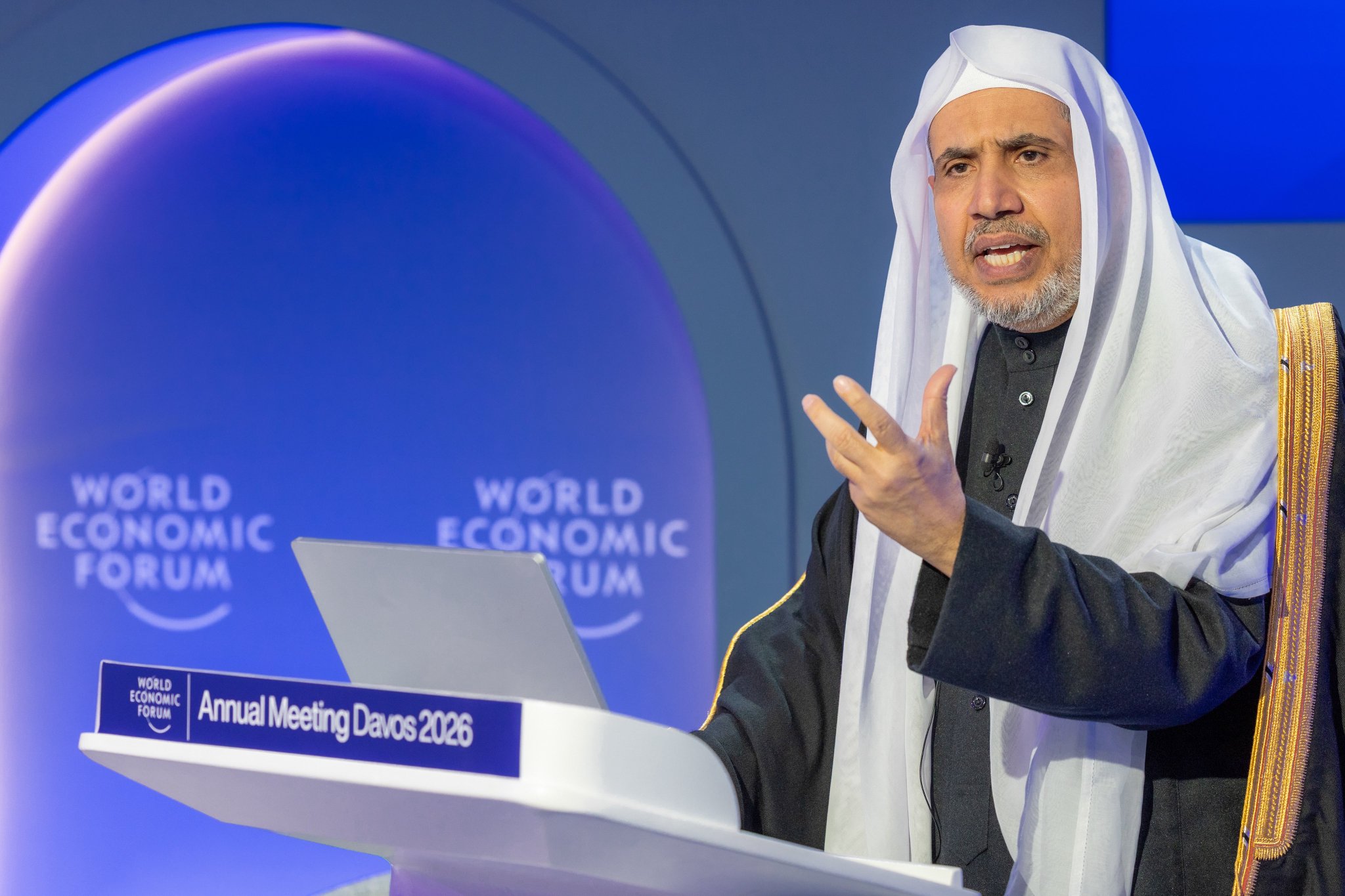
H.E. Dr. Mohammed Al-Issa, took part in the main dialogue session at the Davos Forum on ‘The Moral Responsibility of Religious Leaders in Conflicts.
Latest NewsThis morning at the 2026 Davos Forum:
His Excellency the Secretary-General, Sheikh Dr. Mohammed Al-Issa , took part in the main dialogue session at the Davos Forum on ‘The Moral Responsibility of Religious Leaders in Conflicts.’
In his remarks, His Excellency emphasized the importance of religious leaders endorsing and supporting the New York Declaration, issued last July by the High-Level International Conference for the Peaceful Settlement of the Palestinian Question and the Implementation of the Two-State Solution, co-chaired by the Kingdom of Saudi Arabia and the French Republic. The declaration was adopted by the United Nations General Assembly with a majority of 142 votes, as a just and wise option.
He also stressed the importance of genuine and tangible awareness among religious leaders that human life and human dignity — including the protection of lives, rights, and legitimate freedoms — constitute a supreme value to which every human being is entitled as a universal principle.
He called for removing any sense of immunity or sacredness from practices that are used to justify injustice and oppression, affirming that silence in such matters does not amount to neutrality, but rather to complicity. He urged exposing the falsity of exploiting religious texts as tools to ignite unjust wars or to deny legitimate rights.
Speaking about the tragedies of killing, he said: ‘Any text that is taken out of context to legitimize killing is a betrayal of the text itself.’
He added: ‘Justice is indivisible, and there can be no selectivity in dignity or compassion.’
He went on to say: ‘Dehumanizing the other is the first step toward every humanitarian catastrophe — and toward the chaos of our world. Innocent blood has no classification that elevates some lives over others.
He said: ‘True religious leaders are not spokespeople for power; rather, they are guardians of virtue and justice, and advocates of dialogue and peace.’