

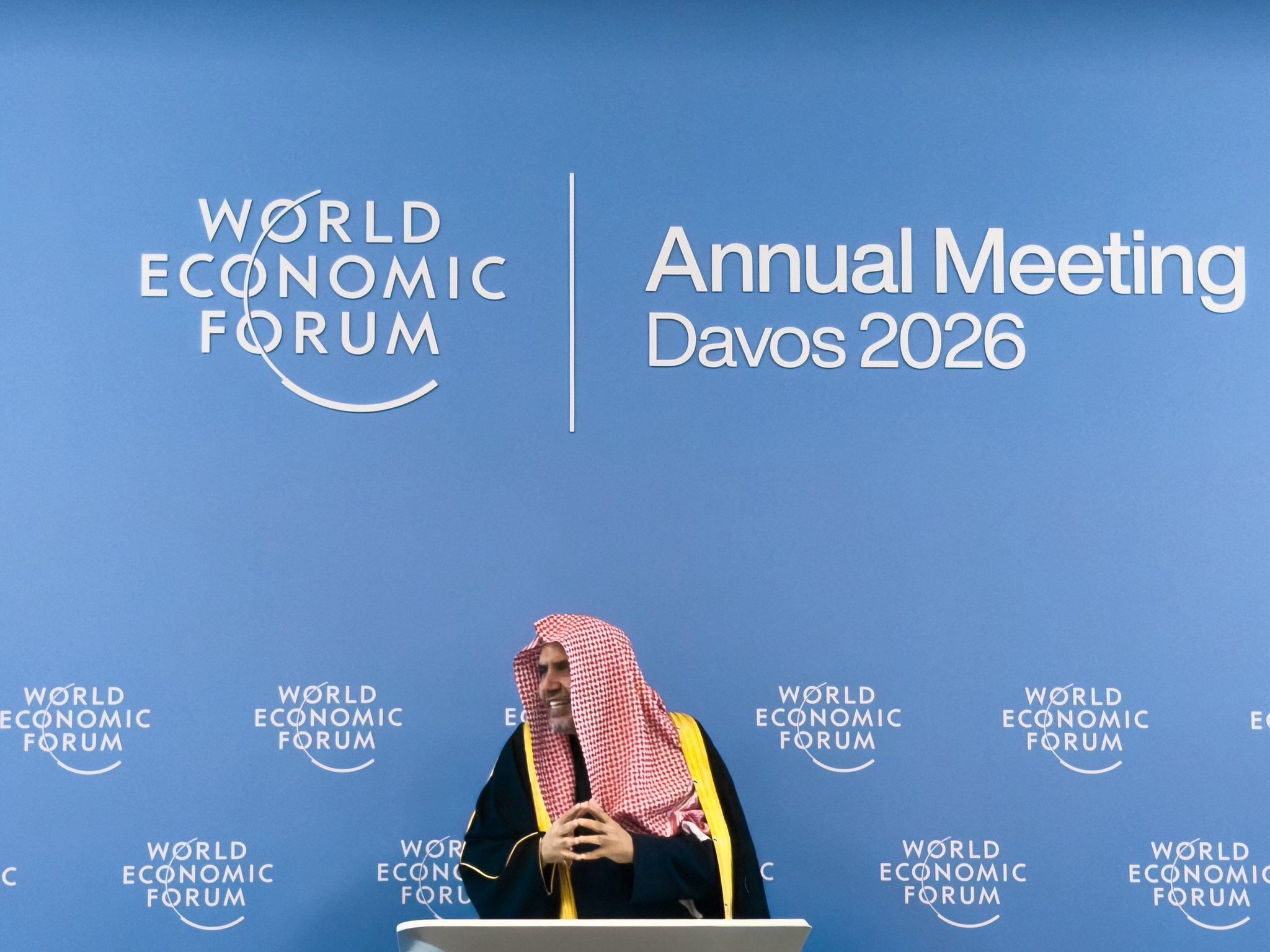
The Davos Forum 2026 selected His Excellency Sheikh Dr. Mohammed Al-Issa, Secretary-General, to deliver the closing address for the religious and intellectual participation
Latest NewsThe Davos Forum 2026 selected His Excellency Sheikh Dr. Mohammed Al-Issa, Secretary-General of the Muslim World League (MWL) and Chairman of the Organization of Muslim Scholars, to deliver the closing address for the religious and intellectual participation.
During the “dinner session”—which is attended annually by leading researchers, intellectuals, and representatives of research centers—His Excellency focused on a number of initiatives, programs, and successful experiences from the global work of the Muslim World League.
He also reviewed prominent models that have had a tangible positive impact, including an initiative by the MWL that was welcomed and supported by the United Nations at its headquarters in New York, titled “Building Bridges of Understanding and Cooperation between East and West.” This initiative represented the first comprehensive international initiative with executable programs aimed at correcting the concepts of the inevitability of clash and civilizational conflict—concepts that have been among the main drivers of hate practices and the dangerous consequences that result from them.
He affirmed that Islam—while fundamentally a monotheistic faith—is a comprehensive system of legislation within an ethical framework that views the human being as an honored and accountable creature, responsible for all words, actions, and choices. He noted that its teachings emphasize justice as a core value for ensuring social stability and safeguarding human dignity and rights, without any discrimination based on race or religious affiliation.
Dr. Al-Issa also explained that mercy lies at the heart of the Islamic worldview as a central human value, guiding how people are treated and how differences are approached in a morally balanced manner. He further emphasized, through examples, that Islam calls for peace and tolerance as the foundation of sound human relations, where coexistence is regarded as the norm rather than the exception.
His Excellency stated: “From this perspective, Islam aligns with the shared humanitarian principles embraced by the contemporary world, as reflected in the Charter of the United Nations and the laws, norms, and international principles derived from it, which focus on safeguarding human dignity, regulating relations, and refining conduct. This is what Islam expressed through the principle of ‘the perfection of noble morals.’”
He further explained that the MWL has worked to bridge relations among the various Islamic schools of thought and to clarify the Islamic civilizational perspective in engaging with our world in its religious, ethnic, and cultural diversity, in addition to addressing a number of important issues such as family, education, the environment, citizenship, and coexistence. This has been achieved through the “Charter of Makkah,” which was endorsed by more than 1,200 muftis and scholars in Makkah, and subsequently adopted by the 57 member states of the Organization of Islamic Cooperation, as well as through the “Charter of Building Bridges between Islamic Schools of Thought and Sects,” under which many initiatives are being implemented.
He added that the “Charter of Makkah” affirmed that Muslims are an active part of this world and its civilizational interaction, striving to engage with all its components for the benefit of humanity; that differences in beliefs, religions, and schools of thought are a universal inevitability; and that all human beings are equal in their humanity and belong to a single origin.
Dr. Al-Issa also noted that the charter highlighted the importance of civilizational dialogue as the best means of understanding within a diverse world, identifying common ground, and overcoming obstacles to coexistence. It also affirmed the innocence of religions and schools of thought from the errors or crimes committed by their adherents or by those who falsely claim them, and rejected any attempt to associate religion with such errors or crimes.
He concluded by emphasizing the importance of global solidarity among all peace-loving institutions to strengthen friendship and cooperation among nations and peoples, through effective joint initiatives and programs whose impact can be measured and developed in a sustainable manner.