H.E. Sheikh Dr Al-Issa Leads MWL Launch of "AI for Everyone" at UN General Assembly
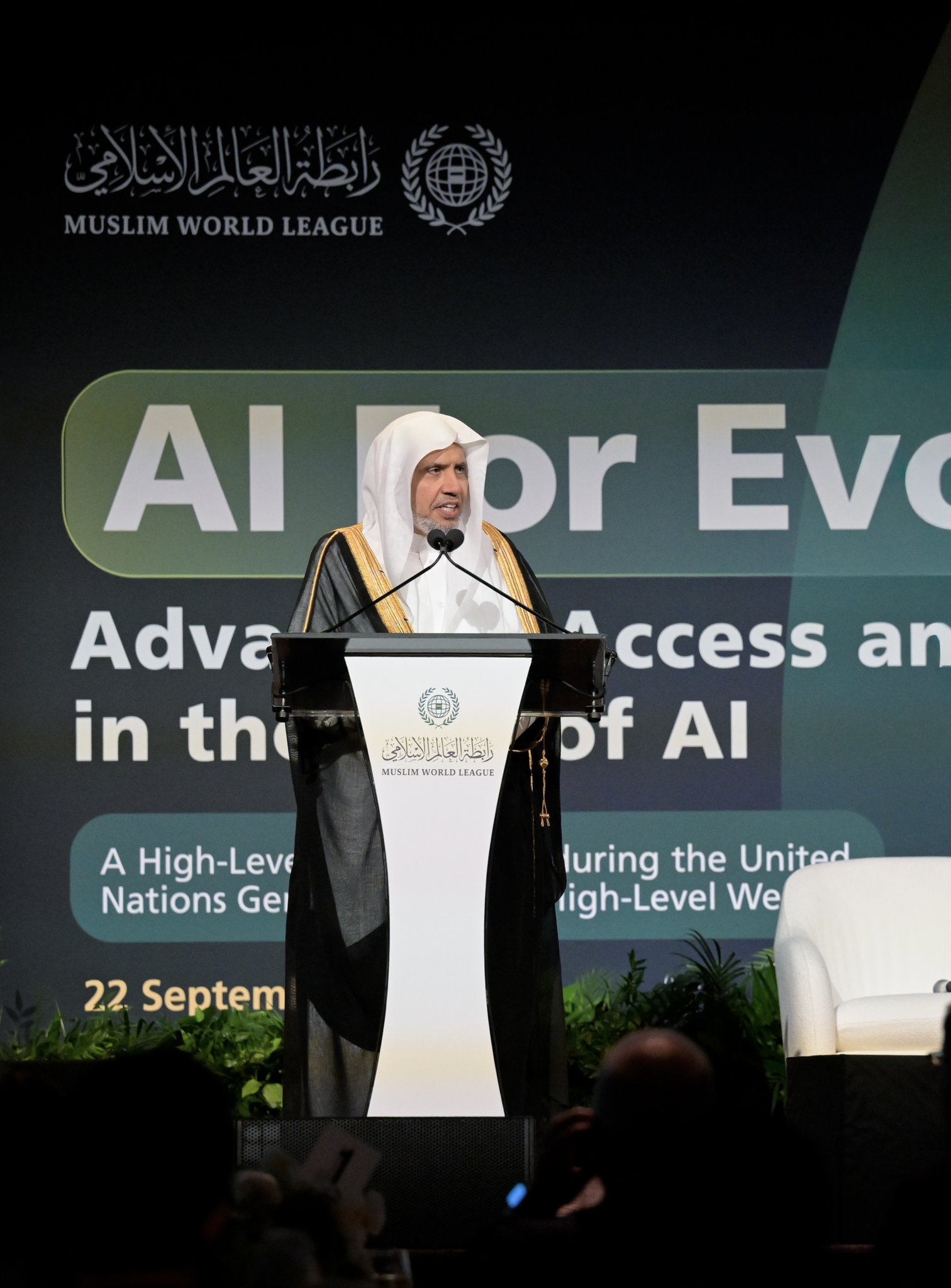
The Muslim World League launched AI for Everyone: Faith, Human Dignity and Artificial Intelligence in New York yesterday evening, during the High-Level Week of the 81st session of the United Nations General Assembly. The event, held with the support of the United Nations, took place in the presence of His Excellency Sheikh Dr Mohammed Al-Issa, Secretary-General of the MWL and Chairman of the Organization of Muslim Scholars.
Participants included His Excellency Mr Miguel Moratinos, High Representative for the United Nations Alliance of Civilizations (UNAOC); His Excellency Mr Ismail Ould Cheikh Ahmed, Secretary-General of the Organisation of Islamic Cooperation; and Her Excellency Ms Rebeca Grynspan, Secretary-General of the United Nations Conference on Trade and Development. They were joined by religious, intellectual, political and academic leaders, and by representatives of research centres working on AI ethics, major US AI companies, the World Bank and leading American universities, as well as prominent candidates for the post of UN Secretary-General.
Nobel Peace Prize laureate Malala Yousafzai, a leading global advocate for girls' education whose work the UN recognises through International Malala Day, also took part and presented her perspective on artificial intelligence.
The event focused on the importance of broad international participation in shaping AI ethics, including religious and civilisational perspectives and the ethical principles they share. This is a significant area of AI ethics, and one for which UNAOC holds the international mandate.
An initial focus is content that promotes or incites hatred, violence and conflict between civilisations, whether driven by religious, ideological or other motives. Technology companies have raised these concerns on the basis of reports they receive about content that falls short in how it treats the beliefs of many users, and are keen to address agreed shortcomings within a UN framework.
A preliminary recommendation emerging from some of the opening remarks and the dialogue sessions that followed called for UNAOC to develop an Alliance of Civilizations Code of Ethics for Artificial Intelligence. It proposed a UNAOC-led committee of religious leaders, experts in intellectual, educational and legislative fields, and technology company representatives, tasked with reaching a UN-based consensus on the issue. Mr Moratinos confirmed UNAOC's full readiness to take this on, and participants thanked him for his positive response.
Dr Al-Issa announced that the MWL will launch an AI laboratory in partnership with technology companies to develop programmes for religious, educational and humanitarian institutions working in religious affairs. He also announced work to digitise a number of Islamic and Arabic sources and books and make them available to AI companies, with due regard for intellectual property rights.
Finally, he announced a dedicated unit to identify and correct translation errors. Significant errors have been found in translations of a number of Islamic texts and related disciplines, producing meanings that bear no relation to the originals and leading to deeply mistaken perceptions and beliefs.